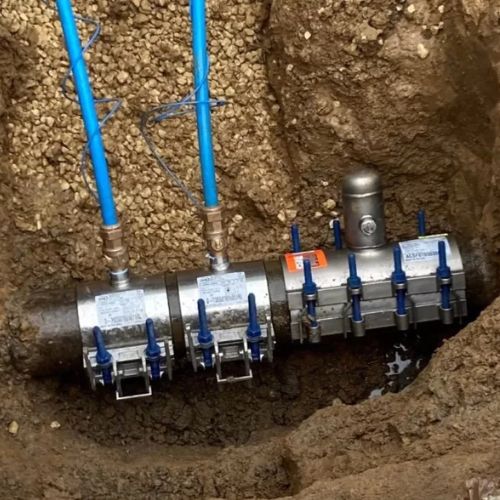
Trenchless lead service line replacement offers Illinois utilities and contractors a way to replace aging underground water pipes with less excavation and property disruption. Solutions such as the Kobus Pipe Puller remove existing service lines while simultaneously installing new piping along the same route.
Across Illinois, water systems are working through a problem that has been decades in the making: hundreds of thousands of lead service lines still need to be identified and replaced.
Illinois EPA’s 2020 reporting-year inventory identified 667,275 lead service lines among approximately 3.85 million service lines reported statewide. Another 819,586 lines were listed as being made of an unknown material at the time. While those numbers don’t represent today’s remaining inventory, they help put the scale of Illinois’ service line replacement effort into perspective (Illinois Environmental Protection Agency [Illinois EPA], n.d.).
The work also isn’t limited to the pipe beneath a city street. A service line connects the water main to a home or building, which means replacement projects can extend from public infrastructure onto private property.
For utilities and contractors planning hundreds or even thousands of replacements, how those pipes are replaced matters almost as much as identifying which ones need to go.
Illinois Is Moving From Identifying Lead Lines to Replacing Them
The Illinois Lead Service Line Replacement and Notification Act requires community water utilities to inventory service line materials and develop replacement plans for lead service lines. Water systems with known or suspected lead service lines must continue submitting updated plans, with complete and final replacement plans due to the Illinois EPA by April 15, 2027 (Illinois General Assembly, n.d.).
That process is already translating into work on the ground.
In Moline, for example, the city has identified approximately 4,900 properties with lead or galvanized steel service pipes. Its replacement program is expected to take place in phases over approximately 10 years, with around 390 properties included in the first phase. The city estimates a typical replacement at approximately $11,000 and has secured funding that allows participating homeowners to have their lines replaced at no cost (City of Moline, 2026).
Naperville is undertaking a similar project on a smaller scale. Approximately 220 homeowners are included in its current lead service line replacement project, which is expected to continue into 2027. The city is replacing complete lead service lines with copper and says contractors will use trenchless installation methods whenever possible to minimize impacts to properties and roads (City of Naperville, 2026).
These are individual programs, but they illustrate the practical question communities throughout Illinois are beginning to face: once the lines have been identified and funding is in place, how do you replace them efficiently?
The Work Doesn’t Stop at the Property Line
Service line replacement is different from many larger water main projects because the work can extend directly onto residential property.
For inventory purposes, Illinois EPA defines the service line as the piping and associated components extending from the water main or other potable water source to the building plumbing at the first shutoff valve or 18 inches inside the building, whichever is shorter. Community water supplies are required to inventory service line materials, including privately owned portions (Illinois EPA, n.d.).
That can make the replacement process very visible to homeowners.
A crew may need to work not only near the street but also across a yard, driveway, sidewalk or landscaped area to reach the home. With traditional open-trench replacement, accessing the pipe can require excavation along a significant portion of that route.
For one property, that may be manageable. Across a neighborhood or an entire community, the excavation and restoration work begins to add up.
This is one reason trenchless service line replacement deserves consideration as Illinois replacement programs move forward.
What If the Existing Pipe Could Provide the Path for the New One?
In this situation, the trenchless Kobus Pipe Puller can make a world of difference in the time and cost of a service line replacement. Instead of digging along the entire service line, the Kobus Pipe Puller uses the existing pipe’s route to complete the replacement.
The process is relatively straightforward. Access points are created at each end of the existing service line. The Kobus Pipe Puller pulls the old pipe from the ground while simultaneously pulling the new service line into its place.
The existing pipe essentially provides a path for its replacement.
Because crews don’t have to expose the full length of the old service line, the process can reduce the amount of excavation required compared with conventional open-trench replacement. That can be particularly useful on residential properties where the service line passes beneath or alongside established landscaping and other surface features.
This trenchless method doesn’t eliminate all excavation for every property; however, it gives utilities and contractors another option when evaluating how to approach a service line replacement when limiting restoration costs and inconvenience matters.
Why the Replacement Method Matters at Scale
In Illinois’ situation where communities are embarking on multiyear replacement programs, the difference a cost-effective and time-efficient trenchless solution makes becomes more meaningful. Moline’s approximately 4,900 affected properties provide a good example (City of Moline, 2026). Every one of those properties represents an individual construction project: accessing the existing line, removing it, installing its replacement, and addressing the surrounding property.
Reducing the amount of excavation required on an individual project may seem relatively small when viewed in isolation, but across a larger replacement program, the time, cost and inconvenience of each service line replacement becomes a factor worth considering.
That’s where the Kobus Pipe Puller fits into the Illinois conversation. The state and others like it will need to resolve regulatory and funding hurdles surround lead service line replacement, but the Kobus Pipe Puller trenchless solutions can complete the work of getting an old service line out of the ground and putting a new one in its place faster and cheaper, with less crew members and less destruction. For contractors and utilities, this trenchless pipe pulling alternative provides another method to consider versus traditional dredging. For homeowners, it can mean a replacement process that requires less excavation across their property.
Finding a Practical Way Through Illinois’ Replacement Work
Illinois still has a considerable amount of service line work ahead.
The state’s earlier inventory counted hundreds of thousands of known lead lines, while communities such as Moline are beginning multiyear replacement programs. Illinois law also requires other affected community water supplies to continue developing plans for completing this work (Illinois EPA, n.d.; Illinois General Assembly, n.d.).
One replacement method may not fit all situations, but as utilities and contractors determine how to support multiple replacement projects, trenchless methods can provide another option for reducing the amount of digging required to remove these old services lines and meet compliance requirements.
The Kobus Pipe Puller was built around a straightforward idea: use the path that’s already there.
For Illinois communities preparing for lead service line replacement, it’s another approach worth understanding before the digging begins.
References
City of Moline. (2026). Lead service line letters. https://moline.il.us/1992/Lead-Service-Line-Letters
City of Naperville. (2026). 2026 lead service line replacement project. https://www.naperville.il.us/projects-in-naperville/2026-lead-service-line-replacement-project/
Illinois Environmental Protection Agency. (n.d.). Lead service line information. https://epa.illinois.gov/topics/drinking-water/public-water-users/lead-service-line-information.html
Illinois General Assembly. (n.d.). Lead Service Line Replacement and Notification Act, 415 ILCS 5/17.12.
https://ilga.gov/legislation/ilcs/fulltext?DocName=041500050K17.12
Ready to Simplify Your Service Line Replacements?
Reduce excavation, minimize disruption and improve project efficiency with Dresser’s trenchless pipe replacement solutions. Connect with our team to learn how the Kobus Pipe Puller can support your next project.
See the Kobus Pipe Puller in Action
Planning a Service Line Upgrade?
These Dresser products improve efficiency and control costs:
- Kobus Pipe Puller, the trenchless pipe pulling solution.
- Abandoned Corporation Fitting, which encapsulates encapsulates abandoned corporation stops.
- T3 Wide Range Service Saddle, which saves time, labor and inventory dollars in the water and wastewater piping industries.
Lead Reduction in Water Line
Learn More about TPS Abandoned Corp Fitting
The Problem: This process can create an influx lead exposure into the water main when the lateral and corporation stop is removed.
Our Solution: The TPS Abandoned Corp Fitting solves this problem by allowing the corporation stop to be terminated by completely encapsulating with minimal disruption to the water main thus reducing lead exposure to the new saddle tapped service and installer.
- Allows the corporation stop to be terminated
- Completely encapsulating with minimal disruption to the water main
- Reduces lead exposure to the new saddle tapped service and installer